The frame+The lens
Every pair of glasses is two purchases pretending to be one.
The frame is taste — shape, material, fit, and whose name is on the temple. The lens is physics — index, tint, UV, coatings. They are chosen together, priced together and sold together, and almost nothing you need to know about one applies to the other.
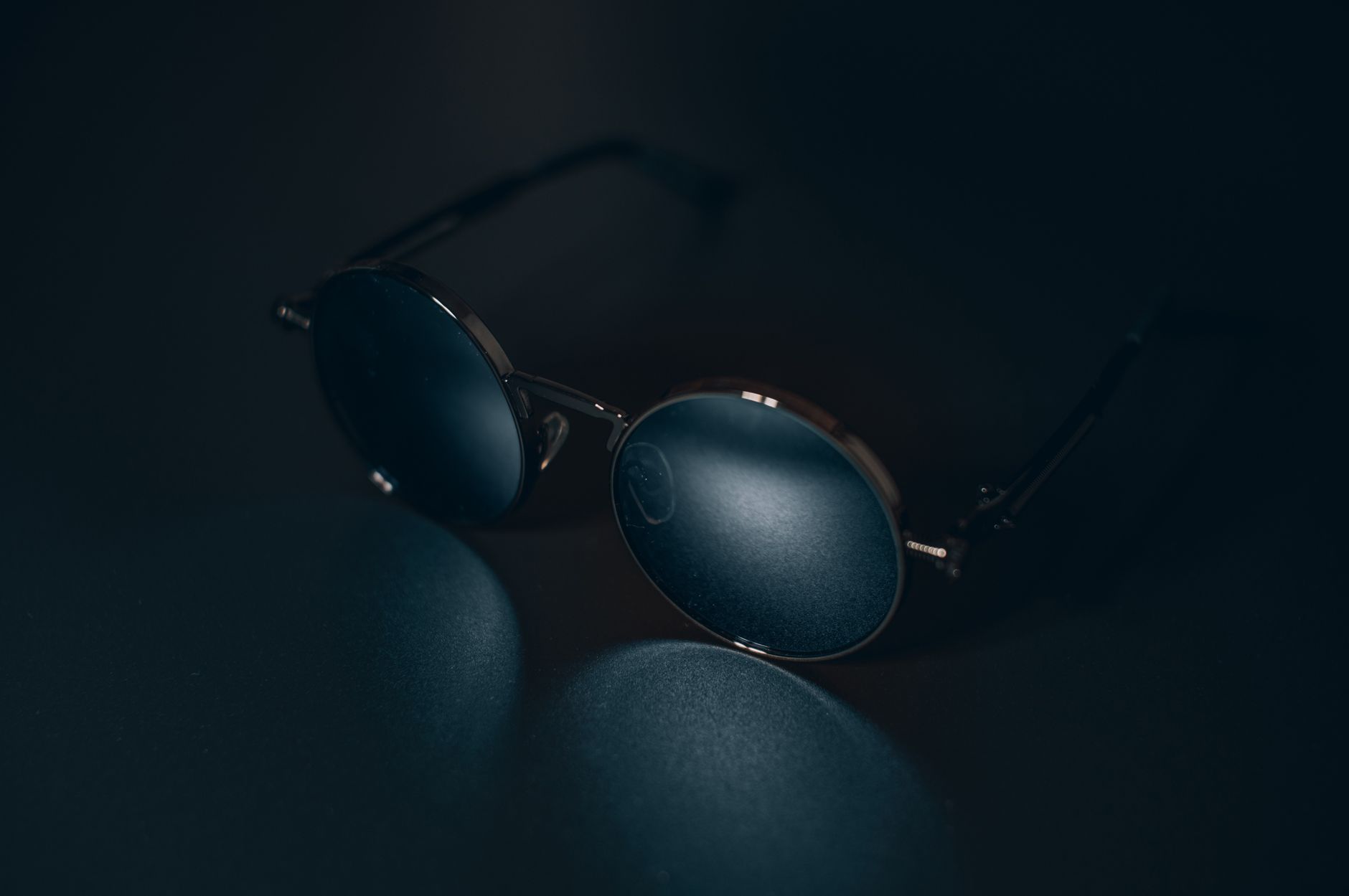
Hero photograph via Pexels.
Frame and lens: two different kinds of decision
A pair of glasses combines two choices that arrive in one box. The frame is the part other people see: its shape, material, construction and the way it sits on your face. The lens is the part you see through: its material, design, coatings and, in sunglasses, its filters. Frame questions are about taste and comfort; lens questions are about optics, and their answers are measurable. Most confusion at the counter comes from treating the two as one decision, which is why the guide to how eyewear works keeps them apart and the choosing glasses hub puts them back together.
One thing sits outside both halves. What your eyes need is decided by an eye examination with an optometrist or ophthalmologist, not by an article. A prescription is a medical record: this site explains what its terms mean, and what to take away from an eye exam covers what to ask for, but applying it to your eyes is the examiner’s job. A sudden change in vision, eye pain, flashes, new floaters, halos around lights or vision loss in one eye calls for a professional the same day. For eye health itself, the American Academy of Ophthalmology’s eye-health pages are written for the public.
How a frame is shaped, built and made
Shape carries history
Most shapes worn today are revivals, and knowing where one came from tells you what it will say on a face. The cat-eye and the browline were mid-century signatures, and the aviator was designed around a job before it became a look. Choosing glasses for their looks at all is newer than it seems, as how glasses became an accessory traces.
Beyond its outline, a frame is defined by how much of the lens it holds: full rim, half rim and rimless differ in durability, visibility and how much lens edge they show. Face-shape rules, such as angular frames for round faces, are in our view styling conventions rather than science. They are useful starting points that plenty of people look better ignoring, which is the argument of whether face-shape rules hold up.
Materials decide how a frame feels after a year
Most plastic frames are either cellulose acetate or injection-molded plastic. Acetate is cut from colored sheets or blocks, so the color runs through the material, and it can be polished and reshaped with heat. Molded frames are formed in a mold, often with the color applied to the surface. Acetate versus injection-molded plastic sets out what that changes in daily wear.
Monel, a nickel-copper alloy, is common because it is easy to work, and it is usually plated. Titanium is light, strong and resists corrosion. Horn frames respond to moisture and dryness in ways plastics do not. Every finish ages, and plating wears through first wherever skin and sweat touch it.
Construction is where two similar frames part ways
How a frame is made follows acetate from sheet to finished pair, through cutting, shaping and polishing. Hinges usually fail first, and a spring hinge, which flexes outward, wears in its own ways. Clean joins, even polishing and hinges that open smoothly, more than any logo, are what makes a frame look expensive.
Fit: where the frame sits decides comfort
A frame fits when the lenses sit in the right place in front of your eyes and its weight rests where it should. Start with the numbers printed inside the temple: lens width, bridge width and temple length, in millimeters. They let you compare any frame with one you already find comfortable. Frame width relative to your face sets proportion, temple length decides whether the arms hold behind the ear or press on it, and the bridge carries most of the weight, which is why adjustable nose pads exist. Pantoscopic tilt, the forward angle of the lens plane, affects both the look and the optics.
Most fit complaints, from glasses that slide down to marks on the nose or pressure behind the ears, trace back to those few measurements. Many can be corrected by an optician bending the temples, resetting the pads or changing the tilt, and what adjustment can and cannot fix sets the limits. Discomfort that does not settle, or anything that seems like a change in your vision rather than your frame, goes back to whoever examined your eyes.
Lenses: material, design, coatings and the sun
What the lens is made of, and how it is shaped
A lens works by bending light, and how strongly a material bends it is its refractive index. What a higher lens index changes is mainly thickness: a higher-index material needs less of itself to reach the same power. The trade is that such materials tend to reflect more light and can show more color fringing toward the edges, which is what Abbe value describes. Trivex and polycarbonate are both impact-resistant but differ in clarity and weight. Which material suits a prescription is for whoever fills it to say.
A single-vision lens carries one correction across its whole surface. Lenses for more than one distance either divide the surface into visible zones or blend them, which is the bifocal versus progressive distinction. Whatever the design, each lens’s optical center has to sit in front of the pupil, and pupillary distance is the measurement that places it. It is taken by a professional, not guessed from a photo.
Coatings each do one job
A coating is a thin layer with a single purpose. An anti-reflective coating cuts reflections from the lens surfaces, and a scratch-resistant coating resists fine abrasion without making the lens scratch-proof. A scratched lens generally cannot be polished back, so cleaning without scratching matters more than any coating. Blue-light filtering is where marketing runs furthest ahead of the evidence, and what the blue-light evidence shows separates the claim from what has been shown.
Sunglasses: tint is comfort, the UV filter is protection
A dark lens is not sun protection. Tint reduces brightness, so the pupil opens wider, and if the lens does not also block ultraviolet, more UV can reach the eye than with no sunglasses at all. That is why dark lenses without UV protection are worse than none. Protection comes from the filter, labeled UV400 or as blocking all UVA and UVB, not from how dark the lens looks or what the pair cost. What a UV400 rating means takes the label apart, and the American Optometric Association’s healthy-eyes pages add guidance from optometrists.
The rest of a sunglass lens is about comfort and clarity. Polarized lenses cut glare reflected off flat surfaces such as water and roads, but polarization and UV protection are separate properties. Photochromic lenses darken in response to UV, which is why they change little behind a car windshield that already blocks most of it.
Designer names, lookalikes, and buying well
Many fashion houses do not make their own glasses. They license their name to specialist eyewear companies that design, manufacture and distribute frames under it with the house’s approval, and who actually makes licensed frames explains the arrangement. Part of a designer price is the name itself, and what you pay for in a designer frame separates that from materials and making.
A lookalike borrows a shape without the name. Classic shapes are shared across the trade, so a lookalike can be a sound frame or a poor one. A counterfeit is different: it copies the trademark itself, and its markings, including any UV claim on sunglasses, are only as trustworthy as whoever made it. Judge any pair the same way, by materials, hinges, finish, fit and the lens behind it. Comparing two frames at the same price works on any label.
The lens can cost more than the frame or far less, depending on the prescription and options, which is why splitting the budget between frame and lenses is worth deciding before you shop, and what drives the price of glasses lays out the rest. An optician can answer most of it, and questions worth asking an optician lists the useful ones. Buying online works best when you already know your measurements and what fits you. The limits of buying glasses online start with the fact that no website can adjust a frame on your face.
The whole site, in one diagram
Two halves. Two entirely different questions.
Everything we publish sits on one side of this line or the other. Brass is always the frame; steel is always the lens. Once you can see which half a claim belongs to, most eyewear marketing stops working on you.
The frame
The part everyone else sees. Almost every decision here is aesthetic, reversible, and genuinely yours to make on taste alone.
The lens
The part you look through, and the part nobody photographs. Every decision here is a measurable trade, and none of it is a matter of taste.
- IndexHow thin the lens gets, and what you trade for it.
- Tint & UVDarkness is comfort. UV400 is protection. They are separate purchases.
- CoatingsAnti-reflective, oleophobic, scratch. Which survive, and which do not.
- DesignSingle vision, progressive, occupational — and the adaptation nobody warns you about.
The seam is where the money hides
You are quoted one price, and the split inside it is almost never shown to you. A licensed designer frame carries a royalty on the half that is pure taste; the lens behind it — the half that actually determines what you see — is where index, coatings and Abbe value silently add or subtract far more. This is the single most useful thing to hold in your head at the counter, and it is the reason we separate the two everywhere on this site.
The steel side, decoded
What each lens claim tells you — and what it does not
Every one of these appears on a lens packet, and every one of them is true. The second half of each card is the part that never gets printed.
Two things we repeat
The parts we will not soften
A dark lens with no stated UV rating is worse than no sunglasses at all.
A tinted lens opens your pupil. If the tint is not paired with UV400, it lets more ultraviolet into a wider pupil than bare eyes would. Darkness is comfort; the UV rating is protection, and they are not the same claim.
Face-shape rules are styling conventions, not science.
“Round faces need angular frames” is a useful starting point and nothing more. No study underwrites it. What actually decides whether a frame works is where it sits, how wide it is relative to your face, and whether you like looking at it.
Recently
Newest writing
- Octagonal Frame vs Hexagon: Why More Sides Reads SofterFrames & Styles
- What Is a Hexagonal Frame, and Who Does It Suit?Frames & Styles
- What Is a Combination Frame, and Why Mix Metal With Acetate?Materials & Craft
- What Is a “Forever” Frame, and Does It Exist?Frames & Styles
- Why Do Some Frame Shapes Date Faster Than Others?Frames & Styles
- What Is Quiet Luxury in Eyewear? A Style ExplainerTrends & Icons
- How Did Glasses Go From Medical Device to Accessory?Trends & Icons
- What Does a Coloured Lens Signal? A Style ExplainerLenses & Coatings
Everything, by subject
Where things live
Where this site stops
We explain what eyewear is, how it is made and what the specifications mean. We do not examine eyes, and an article cannot see yours.
- We never read a prescriptionNo lens power, index, prism or axis, and never a view on whether you need correction. That is an eye examination, and it is not something a website can do.
- We never explain away a symptomSudden changes in vision, eye pain, flashes, floaters or haloes around lights are an appointment, not an article. We will not offer a reassuring explanation for any of them.
- No ranked picks, nothing we have “tested”No best-of lists and no model named as a recommendation. We have not worn these frames, and a list that pretends otherwise is an advertisement.
- No pricesThe same frame costs different money in different markets, and the lens behind it can cost more than the frame or a fraction of it. Any figure we printed would be wrong somewhere.